
Downtime can be one of the most expensive parts of a construction project.
Not the steel. Not the labor. The productivity lost when your operation slows or stops.
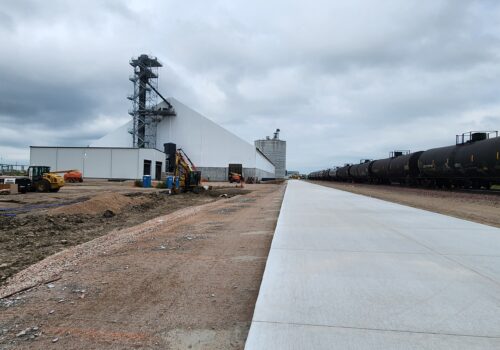
For agricultural and industrial facilities, construction often happens alongside an operation that cannot simply shut down for several weeks. Trucks still need to move. Grain needs to be received, stored, transferred, or loaded out. Processing equipment needs to remain accessible. Employees need safe routes through the facility.
Some disruption may be unavoidable. The goal is to understand where construction and operations will intersect and develop a plan for managing those points before crews arrive on site.
At Greenfield Contractors, that means looking beyond what is being built to understand how the facility needs to keep performing throughout construction. Greenfield’s approach emphasizes operational awareness, including workflow, throughput, storage ROI, and uptime demands.
Before developing the construction sequence, the project team needs to understand the operation.
These operational conversations identify potential conflicts while there’s still time to plan around them.
For an active grain facility, for example, temporarily closing an access point may affect much more than traffic. It could change truck flow, create longer queues, interfere with receiving, or shift congestion to another part of the property.
Likewise, taking a piece of equipment offline for a tie-in can affect other equipment upstream and downstream.
The earlier the dependencies are understood, the better the construction team can plan around them.
One of the most important conversations before construction begins involves equipment tie-ins.
An expansion rarely operates completely independently from an existing facility. New conveyors, electrical systems, grain-handling equipment, storage, utilities, or processing systems may eventually need to connect to infrastructure already in operation.
Those connections can become critical points in the schedule.
Ask early: What has to come offline to make this connection, and for how long?
Once that is known, the team can determine what needs to happen before the shutdown occurs. Materials can be staged. Equipment can be prepared. Crews can be coordinated. Other work can be completed in advance so the interruption is focused on the work that truly requires the existing system to stop.
A planned outage and an unexpected outage may last the same number of hours, but they can have very different effects on an operation.
Construction sequencing should account for more than the most efficient order for the contractor. It should also consider the operational consequences of each phase.
Can one portion of the project be completed while another area remains operational? Can site work occur without restricting critical traffic? Can a new system be substantially completed before taking the existing system offline for the final connection?
Those questions matter most on large, complex projects involving multiple contractors, equipment suppliers, and specialized trades.
Greenfield positions its work around full-scope coordination and accountability from planning through completion, particularly on complex agricultural and industrial facilities.
That coordination matters because one change in sequence can affect several other parts of the project, and the facility operating around it.
Access is easy to take for granted until construction changes it.
Laydown areas, cranes, excavation, temporary fencing, deliveries, and construction equipment all require space. On an active agricultural site, that space may overlap with truck routes, employee parking, loading areas, or equipment access.
Map those conflicts before mobilization.
Determine which routes must remain open and whether temporary routes are needed. Consider turning radiuses and the size of vehicles moving through the property, not simply whether a lane technically remains accessible.
Access planning should also account for emergency response and safe separation between construction activity and facility operations.
The objective is straightforward: construction needs room to happen safely without unnecessarily restricting the work the facility still needs to accomplish.
Every agricultural operation has periods when downtime becomes especially costly.
For grain facilities, harvest is the obvious example. Other operations may have critical receiving, shipping, application, production, or maintenance windows.
Those periods should be part of the construction discussion from the beginning.
If a facility needs additional capacity operational before harvest, the schedule needs to work backward from that deadline. Long-lead equipment, engineering, site preparation, structural work, electrical installation, commissioning, and equipment tie-ins all need to fit within that window.
Waiting until construction is underway to discuss operational deadlines limits the available options.
Even a well-planned project will encounter changes. Weather shifts. Equipment delivery dates move. Existing conditions may be different from what was expected. Another contractor may need additional time.
What matters is how quickly those changes are communicated and how effectively the team understands their impact on both construction and operations.
Facility leadership should know when work will affect access, equipment, utilities, or production. Contractors need to understand changes in the owner’s operating schedule as well.
Clear communication allows both sides to adjust before a scheduling issue becomes an operational problem.
A construction project should ultimately improve an operation, not create unnecessary disruption on the way there.
Greenfield’s asset-protection approach treats every project as a capital investment that should help protect product, safeguard long-term revenue, minimize downtime, and reduce lifecycle risk.
That starts well before construction.
Understand how the facility operates. Identify critical tie-ins. Protect access. Sequence work intentionally. Plan around peak periods. And keep communication moving as conditions change.
You may not be able to eliminate every interruption. But when uptime is treated as a project requirement from the get-go, you can build the construction plan around what matters most: keeping your operation moving while building what comes next.


Copyright © 2026 Greenfield Contractors - All Rights Reserved. | Privacy Policy | Designed by: 309 Marketing